March 17, 2005
BY ALGIS J. LAUKAITIS
Lincoln Journal Star
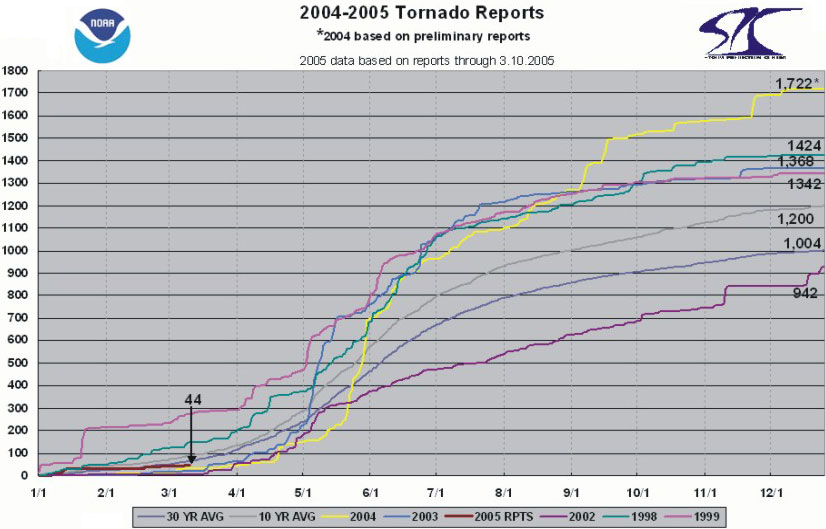
 Last year was a big year for tornadoes in Nebraska, maybe the biggest ever: 110 tornadoes touched down across the state including the one that ripped through Hallam, a town in southern Lancaster County. It was an all-time record for the state, dating back to 1950. But why?
Weather experts say there is no definite answer. They say it is impossible to forecast how many tornadoes will hit in any given year. For example, in 1950 there were only six verified tornadoes.
"Year to year, the variability is huge. There is not a consistency from year to year, making it difficult to predict," said Ken Dewey, a regional climatologist with the University of Nebraska-Lincoln School of Natural Resources.
The record-breaking tornado year of 2004 and the tornado that ripped through Hallam will be the subject of Saturday's Central Plains Severe Weather Symposium at Lincoln East High School. About 2,500 people attended the symposium last year.
This year's symposium will feature photographs of the F4 tornado, believed to be the widest ever measured, as it passed through Hallam. It will also feature stories from area residents who had their homes swept away by the tornadoes, and rescue and emergency management workers about their roles in helping cope with the Hallam disaster.
Scott Dergan, a meteorologist with the National Weather Service in Valley, said meteorologists can only say that certain atmospheric conditions are conducive to tornado development. Beyond that, he said, when and where a tornado will touch down is impossible to predict.
Tornadoes can occur in any month. In eastern Nebraska, the biggest tornado months are May and June, because that's when the cold temperatures clash with warm temperatures. In July, the weather turns very hot, decreasing chances for a lot of tornadoes.
Nebraska also experienced another record last year: The most tornadoes ever recorded for the month of May — 76. And 37 of those tornadoes occurred on May 22, the day a two-mile wide tornado hit Hallam. The F4 tornado is believed to have had the widest path ever measured.
Dewey said Hallam residents were very fortunate. He said if the tornado would have shifted one mile to the north, the destruction would have been much greater.
"The worst part of the tornado actually missed them," Dewey said. "The strongest winds were to the south of town."
Why so many tornadoes in one month? Don't blame it on weather phenomena like El Nino or La Nina, Dewey says. Blame it on the weather patterns that move and sometimes collide over our state.
"The frequency of tornadoes in Nebraska is dependent on the shifting weather patterns in spring and summer," Dewey said. "They are not controlled by any weather phenomena."
The rise in tornadic activity in recent years may also be the result of more people keeping an eye out for tornadoes.
"There are more (tornadoes) because we see more because there are more people looking," he said. "Six of the last seven years were unusually active in the state of Nebraska."
Said meteorologist Dergan: "We have (storm) spotters out in much greater numbers now. ... Everybody has a video camera. We also have more confirmation because of the technology."
Reach Algis J. Laukaitis at 473-7243 or alaukaitis@journalstar.com.
1http://www.spc.noaa.gov/faq/tornado/
http://www.journalstar.com/articles/2005/03/17/local/doc4238c34ea2e08895908387.txt